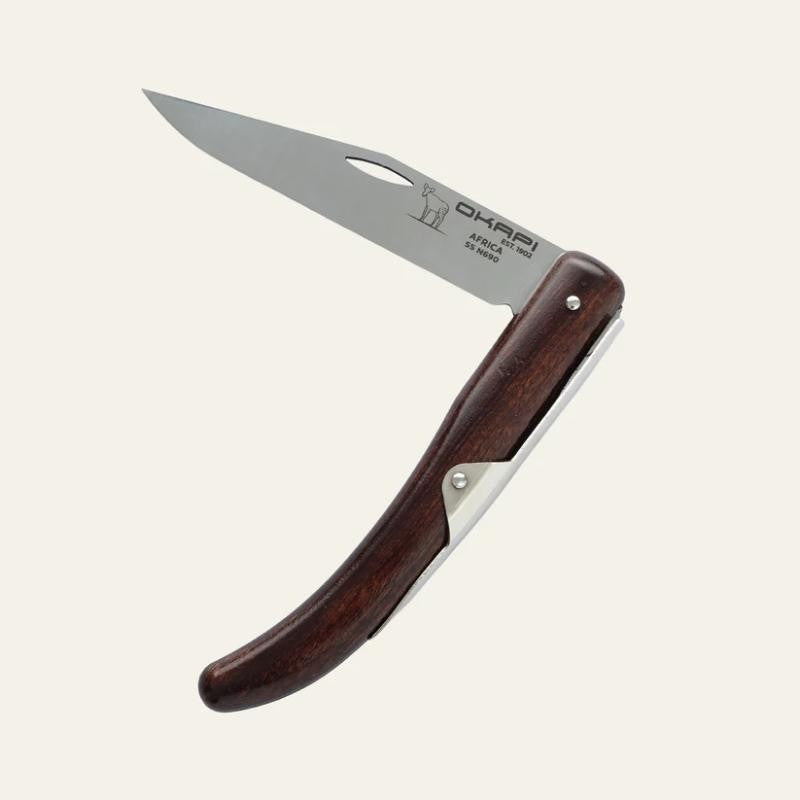
The Okapi Folding Knife in its wood-handle guise is the modern factory successor to a shape every South African recognises on sight: a slim, clip-point folder with a drop handle, sold since 1902 and still made in South Africa today. This version keeps the stabilised wood scales and satin N690 stainless blade that Okapi uses on its everyday-carry range, and drops it into a card sleeve box rather than the loose trade-counter sale the brand is historically known for. It sits in the shop as an affordable, honest pocket knife rather than a collector's showpiece, and it is built to be used, lost, and bought again without a second thought.
What sets this model apart from the classic ratchet-lock Okapi (the 907E) is the blade steel and the mechanism. Where the old-school Okapi runs plain carbon steel and a ratchet lock that clicks open tooth by tooth, this one uses N690 stainless steel at 58-60 HRC and a simple slip-joint back-spring, closer in feel to a traditional Opinel or a classic Scout knife than to the agricultural original. The result is a blade that resists rust far better in a damp cooler bag or tackle box, at the cost of the ratchet lock's resistance to accidental closing under hard push cuts.
At under 250mm open and roughly 100g, it disappears into a jacket pocket or glovebox.
Key Features
- N690 stainless steel blade at 58-60 HRC holds a working edge through a full braai season and shrugs off the odd splash of lemon juice or brine that would start carbon steel rusting within the hour.
- Stabilised wood handle scales are resin-impregnated so they do not swell, crack or dry out the way raw timber would after repeated washing, while still giving the warmer grip and heavier feel that plastic-handled folders lack.
- Slip-joint back-spring holds the blade firmly open or closed without a lock release to learn, so it opens and folds the same way every time and needs no maintenance beyond an occasional wipe.
- A 2.3mm blade spine with a single-sided 30-degree edge bevel keeps the clip-point thin enough for fine work like skinning or biltong slicing, while the spine thickness stops it flexing under harder cuts.
- Compact 240mm overall length with a roughly 100mm blade sits comfortably within what most South African retailers and shows carry as an everyday pocket size, small enough for daily carry yet long enough for kitchen and field tasks.
- Supplied boxed, which keeps the blade edge protected in transit and makes it ready to give as a gift rather than arriving loose as the trade-stall original often did.
Technical Specifications
| Brand |
Okapi (Okapi South Africa, est. 1902) |
| Blade length |
100mm (4.0 in), some batches listed at 105mm (4.13 in) |
| Handle length |
140mm (5.5 in) |
| Overall length (open) |
240mm (9.4 in) |
| Blade material |
N690 stainless steel |
| Blade hardness |
HRC 58-60 |
| Blade thickness |
2.3mm |
| Edge bevel angle |
30 degrees, single-sided |
| Blade grind/tip |
Clip point with thumb-opening nail nick |
| Handle material |
Stabilised wood |
| Locking mechanism |
Slip-joint back-spring (non-locking) |
| Packed weight |
approximately 100g (typical) |
| Country of manufacture |
South Africa |
| Packaging |
Branded card box |
Materials & Construction
The blade is bar stock N690, an Austrian-origin stainless steel widely used across the Balkans and South African knife trade for its balance of edge retention, toughness and ease of resharpening compared with harder powder-metallurgy steels. At 58-60 HRC it sits in the sweet spot for a working pocket knife: hard enough to hold an edge through a day of cutting, soft enough that a butcher's steel or a basic stone brings it back without specialist equipment. The handle scales are pinned to a steel liner with brass-coloured pins visible on both faces, and the stabilised wood has been resin-treated so it will not absorb water, swell or split the way an untreated timber scale would after repeated hand-washing.
Brand Background
Okapi traces back to 1902 in Solingen, Germany, built as an inexpensive folding knife for German colonial markets in Africa. Production moved to South Africa in the late 1980s when a local company bought the trademark and tooling, and the brand was acquired by Lasher Tools in 2019. The name remains shorthand in local slang for any cheap, reliable folding knife regardless of maker.
Care & Maintenance
Hand-wash and dry the knife immediately after use on anything acidic or salty; N690 resists corrosion far better than the brand's older carbon-steel blades but is not stainless-proof against being left wet in a sheath overnight. A drop of light oil on the back-spring pivot once or twice a year keeps the action smooth. Because it is a slip-joint rather than a locking knife, sharpen with normal care and avoid using it as a pry bar or for cuts that push hard against the spine.
Who It's For
This suits a buyer who wants a traditional South African pocket knife for biltong, camping, fishing or general outdoor use and would rather have stainless steel and a wood handle than the brand's original carbon-steel ratchet-lock knife. It is a sensible first knife for a teenager heading off to boarding school or varsity, a glovebox or tackle-box spare, or a small gift that still carries real local heritage rather than an imported novelty blade.
FAQ
Is this the same as the classic ratchet-lock Okapi? No. The ratchet-lock 907E uses carbon steel and a toothed lock; this model uses stainless N690 and a plain slip joint, so it opens and closes more like a traditional folder.
Does it lock open? No, it is a slip-joint knife held open by spring tension rather than a mechanical lock, which is standard for this style of traditional pocket knife.
Will the wood handle survive regular washing? The scales are stabilised (resin-impregnated) rather than raw timber, so normal hand-washing and drying is fine; prolonged soaking or a dishwasher is not recommended.
What is it best used for? Biltong and food prep, light bushcraft and camp tasks, fishing line and general cutting; it is not built for batoning, prying or heavy-duty bushcraft work.